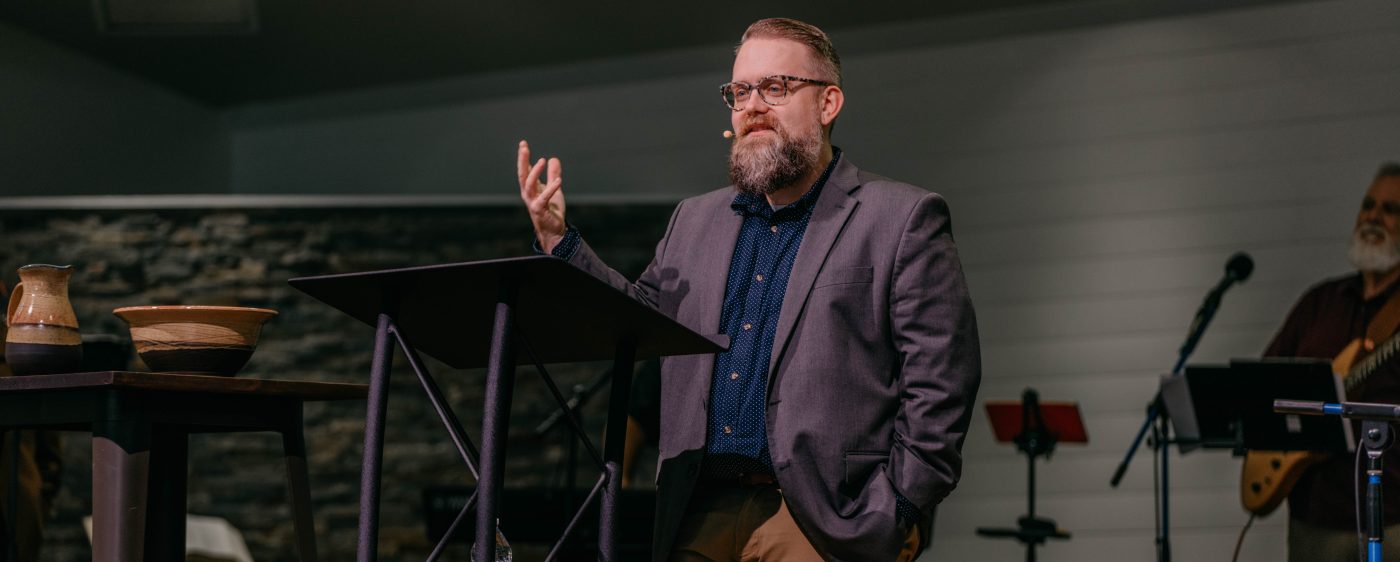
By Pastor Ryan Broadhurst
One of the aspects of communion that Christians have historically practiced is something called “fencing the table”. This simply means we want to put appropriate boundaries around the observance of this holy sacrament so that those who are unbelievers or who are under church discipline might take seriously the admonition of 1 Corinthians 11:27-29, which cautions against taking the elements in “an unworthy manner” without “examining themselves” or “discerning the body”. Far from a harsh, discriminatory practice, we actually believe that this sort of admonition is a loving call to all in attendance to consider the Gospel and their relationship with the Lord (or lack thereof). So a weekly observance of the Lord’s Supper actually allows us to end our services every Sunday with an evangelistic call to faith and repentance. So with that in mind, let me tease out three evangelistic related considerations for us in that regard.
- The Lost: A Call To Believe
Unbelievers are welcome to participate in any and all aspects of our worship services – save one. They’re welcome to sing, sit under the preaching of the Word, give financially, etc. But when it comes to the Lord’s Supper, this is the one part of our Sunday mornings that I tell unbelievers they’re going to have to miss out on. Rather than take communion, I encourage unbelievers to take Christ by faith! I would hate for someone to take the symbol and miss the substance. Of course, more than that I’d hate for them to drink judgment upon themselves, as Paul warns in 1 Corinthians 11. And so, I then invite them to come speak with me or one of the elders at the conclusion of service to talk more about what it means to have faith in Jesus and become a Christian. So as you can see, there’s a clear warrant to refer to the Lord’s Table as the Presbyterian version of the “altar call”!
At the end of the day the point of this is… what makes someone worthy of receiving communion? John Calvin put it succinctly: “This is the worthiness – the best and only kind we can bring to God – to offer our vileness and our unworthiness to him so that in his mercy we may be taken as worthy; to despair in ourselves so that we may be lifted up by him; to accuse ourselves so that we may be justified by him.” Or as Jesus himself puts it in Matthew 5:6, “Blessed are those who hunger and thirst for righteousness, for they shall be satisfied.” To be worthy to receive, in many ways, means to simply come hungry. If we are filled up with our own sin or our own self-righteousness, we are not ready to come to the Table. It is a sacrament reserved only for those who look to Christ and HIS righteousness by faith. By observing it weekly, this will give us that “altar call” moment every week in a biblically appropriate manner. As Paul writes in Romans 10:14-17, “How are they to call on him in whom they have not believed? And how are they to believe in him of whom they have never heard? And how are they to hear without someone preaching?… So faith comes from hearing, and hearing through the word of Christ.” The sacraments are the word of Christ made visible, so what a great way to keep the Gospel before the eyes and ears of the lost in our midst each Sunday.
- The Wayward: A Call To Repent
Another important consideration for us is that, it isn’t just unbelievers who are addressed by the fencing of the table. There are also those who had professed faith in Christ but have since wandered from the Christian doctrine and/or practice that they’ve been called to as members in Christ’s church. Depending upon your church background, you may have experienced different levels of this aspect of fencing the table. Most Christian churches agree that lost people should not partake in communion, but there’s varying degrees of restriction for professing Christians. Some churches practice “open communion” where anyone may partake who says they’re a Christian. On the other end of the spectrum, some churches only allow members of that particular congregation or tradition to partake – a practice called “closed communion”. In the PCA, we observe what I’d call “close communion”. You don’t have to be a member of Westminster or a Presbyterian church to join us in the sacrament of communion. However, we do expect those who partake to be members of an evangelical congregation of some sort.
Often, I will say something like: “If you’re a member in good-standing of a Gospel-preaching church like ours, then you’re invited to join us for communion.” Whether baptist, lutheran, anglican, presbyterian, non-denominational, etc, if they are a member of a Gospel-preaching church, we believe they’re welcome to this sacrament. That’s because it isn’t Ryan Broadhurst’s table, Westminster Presbyterian Church’s table, or the Presbyterian Church in America’s table… it is the Lord’s Table. But it is important that we acknowledge they’re not only members, but members in good standing, which is a short-hand way of saying – you aren’t under church discipline which would bar you from communion.
Historically, when someone has shown their life or beliefs to be out of accord with biblical Christianity, it is their church’s job to admonish them in various stages (as taught by our Lord in Matthew 18:15-17), and if they continue to be unrepentant, they’re also barred from communion. This may sound harsh to our post-modern Western ears, but it is actually unloving to pretend as if we’re in “right communion” with someone who is actually “out of communion” with us and with Christ. Weekly communion, then, also allows us to call wayward brothers and sisters back to the fold. As Jesus says in Matthew 18:17, we are to treat them “as a Gentile and a tax collector” which is to say, do not pretend they’re part of the people of God any longer. But let’s not forget, how exactly does Jesus instruct us to treat Gentiles and tax collectors? We LOVE them and call them to repentance and faith in Christ! I believe God will use and bless our efforts at weekly communion in such a way that those who have wandered, or are tempted to wander, away from the fold of God will be drawn back once more as they consider the truth and hope of the Gospel. May this be one more method by which, as the old hymn says, our Redeemer lets his grace, like a fetter, bind our wandering heart back to him.
- The Christian: A Call To Share
Finally, I believe weekly communion will strengthen our church’s evangelism efforts by how it will more greatly equip all of our members to share the Gospel themselves. One of the beautiful things about it is that no matter what Sunday you invite an unbelieving friend or family member to attend church with you, you’ll know that the Gospel will be proclaimed, and they’ll hear a call to faith and repentance. But in addition to that, it is a good reminder that, as Paul says in 2 Corinthians 5:18-21, we have been given “the ministry of reconciliation” and “we are ambassadors for Christ, God making his appeal through us.” I believe that hearing this clear “Gospel call” every Sunday will, thus, benefit the believers who are present by helping them to have a sort of weekly evangelism training. “Oh, THAT is what I should say to my lost friends.” “Oh, THAT is what it means to share the Gospel.” It really is simple and beautiful to be a part of evangelism. And the more our church is able to witness this when we gather each Sunday, the more competent and confident they’ll feel when it comes to engaging in it themselves as we scatter throughout the week.
As Christians, we have been called to share this incredible Gospel message with the lost world around us. In one sense, evangelism is just “one beggar telling another beggar where to find bread.” May Westminster Presbyterian Church be known as a collection of “beggars” ourselves who can’t help but share about this glorious “Bread of Life”, who alone is the fulfillment of all of our spiritual hunger. And may weekly communion be an opportunity to keep before all of us the desire to see more brought into that “communion” right alongside us.
 Ryan Broadhurst