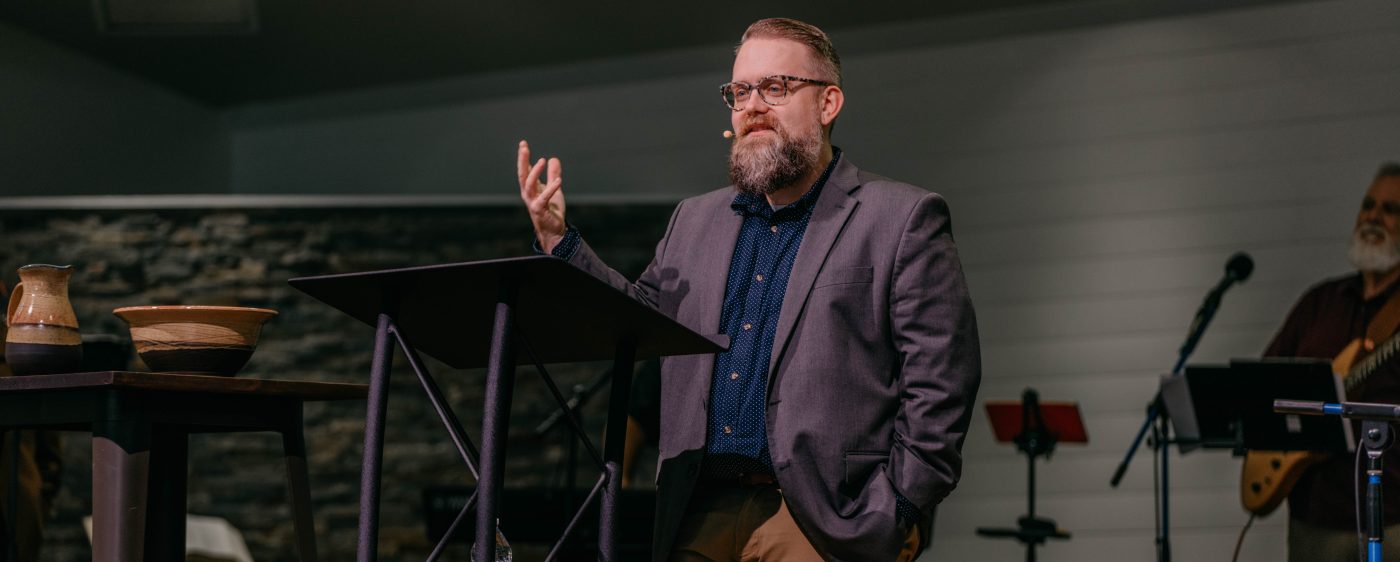
By Pastor Ryan Broadhurst
In the first two articles, I touched on why I believe weekly communion to not only be a biblical approach, but also a real benefit to our relationship with God. In this article, I want us to think about how the weekly observance of this sacrament will also be a benefit to our relationship with one another as fellow brothers and sisters in Christ. Ecclesiology means “the study of the Church”, and so I want us to consider how the practice of weekly communion should promote greater unity, humility, and harmony within our church family.
- Unity: Weekly communion promotes unification with one another. (Acts 2:42-47)
So let me start by asking: What comes to mind when you think of the word “fellowship”? Perhaps it is the Tolkien classic The Fellowship of the Ring. Or maybe it brings to mind fun events or activities where you were able to connect with others in the church. Or it could be that you’re like my wife, who when I asked what came to mind for her, she simply said: “Casserole”. But it’s interesting that the New Testament gives us a specific word for “fellowship”, and it’s the word κοινωνία. In previous articles, we saw how that word κοινωνία speaks to our “fellowship” or “communion” with God, but it also points to our “common union” with one another rooted in the Gospel of Jesus Christ.
In Acts 2:42, we see that the early church believers devoted themselves to this κοινωνία. And then a couple verses later in Acts 2:44 we see that they “… had all things in common.” Far from teaching that people must be forced to give up all their earthly possessions for a sort of mandated socialistic communism, Luke is instead showcasing the early church’s voluntary love, association, and giving towards one another out of this shared fellowship. In fact, this word for “common” in verse 44 is actually the same root word from “communion”. So you see, this deep, rich fellowship shared amongst Christians is important as a reflection of our love for God and one another.
This is one of the reasons the sacrament of the Lord’s Supper is so often referred to as “communion”. It reminds us that we are ALL dependent on and partaking of Christ. Which means that which unites us is far greater than that which divides us. Regardless of your gender, social status, income level, ethnic heritage, racial background, political preference, or your favorite football team… if you are united to Christ, you are united to his people in all their glorious diversity! Weekly communion is a reminder every single week that what makes the church the church is a shared faith in Christ above all else.
- Humility: Weekly communion promotes consideration of one another. (1 Corinthians 11:17-34)
In the quintessential passage on the Lord’s Supper, we see that the church at Corinth was struggling to be humble. Throughout this letter, the Apostle Paul admonishes them for thinking that they were better because of their favorite preacher, the kind of food they ate, or even their particular spiritual giftings. They were so self-concerned, in fact, that in 1 Corinthians 11, we learn that many were engorging themselves on the bread and getting drunk on the communion wine whilst others were not even getting to partake at all! They had made communion all about themselves, their pleasure, their “personal relationship” with God. In light of this “broken fellowship” Paul says that when we partake of the Lord’s Supper, we need to be “discerning the body” (1 Cor. 11:29). This is specifically a reference to the church. We need to be mindful of the wider body of Christ. Division within a Christian body is not a faithful picture of the Gospel, and is therefore not properly partaking of communion. Instead, we need to humbly consider the importance of our fellow brothers and sisters as it relates to communing with one another. In verse 33, we are told to “wait for one another” which means we are to put others’ needs before our own just as Christ put our needs before his.
So you see, what we glean from this passage, and elsewhere in the New Testament, is that the sacrament of the Lord’s Supper is not about “me and Jesus” but rather “we and Jesus”. This is a sacrament of the Church, which means it is inappropriate to observe communion (or baptism for that matter) when alone, in small groups, or even at weddings, as is often popular. Rather, it should take place under the administration of the church and its elders for the sake of the local body as a whole. Thus, when you “discern the body” during communion, it is an invitation to consider others more highly than yourself. It’s a reminder that Jesus died for them just as he died for thee. It takes the eyes off of self and invites us to look around at our fellow believers. The weekly observance of this sacrament is one more way that we can consistently and humbly consider our love for our brothers and sisters, as we consider Christ’s love for them.
- Harmony: Weekly communion promotes reconciliation towards one another. (Matthew 5:23-24)
Related to the issue of “discerning the body” that 1 Corinthians presents us, is the idea that communion is one of the means by which God intends to promote forgiveness and reconciliation amongst his people. While not directly related to the sacrament, Jesus’ teaching in Matthew 5 has some important implications for how our “communion” with God is disrupted when our “communion” with one another is affected by sin. In this passage, Jesus says: “So if you are offering your gift at the altar and there remember that your brother has something against you, leave your gift there before the altar and go. First be reconciled to your brother, and then come and offer your gift.” – Matthew 5:23-24. What we see is that someone who was seeking to be made right with God vertically, must also consider whether they are right with fellow believers horizontally. One relationship always impacts the other.
Who amongst our fellowship do you have lingering bitterness towards? Who should you be going to and asking their forgiveness? Satan would love nothing more than for unresolved conflict, unconfessed sin, and unreconciled fellowship to poison the people of God towards a slow and certain death. But God, in his infinite wisdom, has given us the sacrament of communion to bring regular awareness of our need to be repenting and forgiving one another week in and week out. Therefore, this is just one more reason why the weekly observance of this sacrament would be of great service to our church, through promoting harmonious spiritual communion amongst fellow members. At the Lord’s Table every single Sunday, we will not only be confronted with the question of “How’s my relationship with Christ?” but “How’s my relationship with my brother or sister in Christ?”
 Ryan Broadhurst