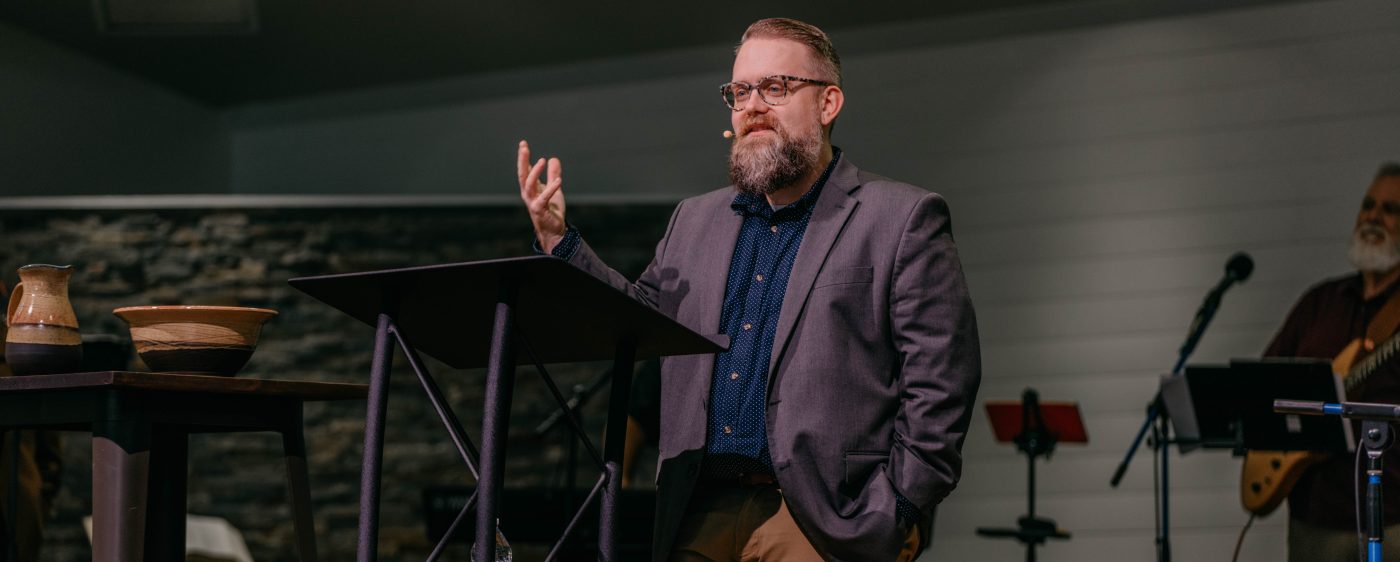
By Pastor Ryan Broadhurst
In my first article, I wrote about how I believe it is biblical to observe communion weekly, and my intent in this article is to show how it is also beneficial to our relationship with the Lord. So let’s start by perhaps the most obvious question: what exactly is a sacrament, and how does it impact our relationship with God? According to the Westminster Shorter Catechism, “A sacrament is a holy ordinance instituted by Christ, wherein, by sensible signs, Christ and the benefits of the New covenant are represented, sealed, and applied to believers.” – WSC #92. There are two sacraments: baptism (the initiatory sacrament) and communion (the ongoing sacrament). In other words, we are baptized only once, as we join the church as a sign of entering the covenant people of God, but we partake of the Lord’s Supper regularly, as the ongoing covenant renewal ceremony of the church. Each time we take communion, we should see it as a sign and seal, as well as spiritually nourishing to our souls. And as we see the importance of these three ideas, I believe it will help us understand more about why it is truly a good thing for churches to observe communion every week.
- Communion As “A Sign”.
In the Lord’s Supper, we have been given a sign that points us to Jesus in a unique way. When we observe this meal, it’s like a billboard declaring to us, “Jesus – this way!” The sign itself is not the point. The sign is merely directing your attention to the substance. It’s a “means” but not the “end”. Jesus is the goal the sign is pointing to. That’s why Jesus said, “Do this in remembrance of me.” – Luke 22:19b, and it is why the Apostle Paul said, “For as often as you eat this bread and drink the cup, you proclaim the Lord’s death until he comes.” – 1 Corinthians 11:26. In both cases, we see that it’s a sign pointing to a greater reality than simple bread and wine.
Historically, the church has often referred to the sacraments as “the Word made visible”. Thus, theologian and author J.I. Packer put it like this: “As the preaching of the Word makes the gospel audible, so the sacraments make it visible, and God stirs up faith by both means.” Thus, when we partake of the bread, it points us to Christ’s body broken for our sins. And when we partake of the wine, it points us to Christ’s shed blood poured out for the forgiveness of those same sins. So you see, the weekly observance of the Lord’s Supper would actually keep this sign before our eyes every single Sunday in a unique way that, by God’s design, communion affords us.
Indeed, our hearts are prone to wander and our gaze is prone to drift away from Jesus, and so weekly communion would be one more way that we are “looking to Jesus, the founder and perfecter of our faith,” – Hebrews 12:2a.
- Communion As “A Seal”.
Not only is communion a sign pointing us in the right direction, but it is also a seal that is placed upon us. We see Paul use this language of sacraments being “seals” in Romans 4:11 for example. In ancient times, a king would use some melted wax to place his unique seal of approval upon a message he intended to convey. That message carried all the authority and power of the king himself and proved he was standing by his word. Communion is like a regular stamp of approval from God placed upon us. Everytime we partake of communion, God is saying to our hearts once more, “This is my beloved Son with whom I am well-pleased.”
It is reminding us of the Good News of our righteous standing before God, as those who have been pardoned through Christ. And as sinners who struggle week in and week out to feel worthy, feel forgiven, or feel accepted by God, this weekly reminder of the Gospel would have such benefit for our souls. So weekly observance of this sacrament would continually keep before our hearts and on our minds, the grace of God in a unique way.
- Communion As “Spiritual Nourishment”.
Now, perhaps you, like me, come from a background where the word ‘sacrament’ was not used very often when talking about the Lord’s Supper. Or perhaps you come from a background where the idea of this meal as a ‘sacrament’ conveyed an overly mystical or unbiblical idea of somehow receiving justifying grace merely by partaking in it. As Reformed Christians, we want to avoid two equal and opposite errors as it relates to this meal. The first error is to say that this meal contains no spiritual significance whatsoever apart from being a mere “memorial ceremony”. And the other error is the danger of saying that communion is salvific, and that we are partaking of the literal body and blood of Jesus. The former says the spirituality of the sacrament is essentially nothing, while the latter says it is absolutely everything. However, the Scriptures teach us an altogether different understanding of how to properly approach the Lord’s Supper as a sacrament.
In 1 Corinthians the Apostle Paul writes, “The cup of blessing that we bless, is it not a participation in the blood of Christ? The bread that we break, is it not a participation in the body of Christ?” – 1 Corinthians 10:16. That word for “participation” used here is κοινωνία, which also means “fellowship”, and it is where we get our word for “communion”. Thus, Charles Spurgeon once put it like this: “We believe that Jesus Christ spiritually comes to us and refreshes us, and in that sense we eat his flesh and drink his blood.” So you see, Christ is not bodily/physically present, for he is seated at the right hand of Father. But he IS spiritually present in a unique way when we come to the Lord’s Table.
So you see, just because we disagree that partaking of this sacrament is a justifying grace does not mean that there is no grace whatsoever for us. Historically, the preaching of the word & the administration of the sacraments were actually called “ordinary means of grace”. They are ordinary means or methods by which God has promised we would uniquely experience his grace & blessing. But they are means to an “end”, and that end is the glory of God and the strengthening of his church. Therefore, this is one more reason that weekly communion should be seen as a positive thing when it comes to the growth of our relationship with the Lord.
So as we consider all the benefits that communion brings us whenever we partake of it, my hope is that it would create a longing in each of our hearts to observe this blessing of a sacrament every time we gather as the church.
 Ryan Broadhurst