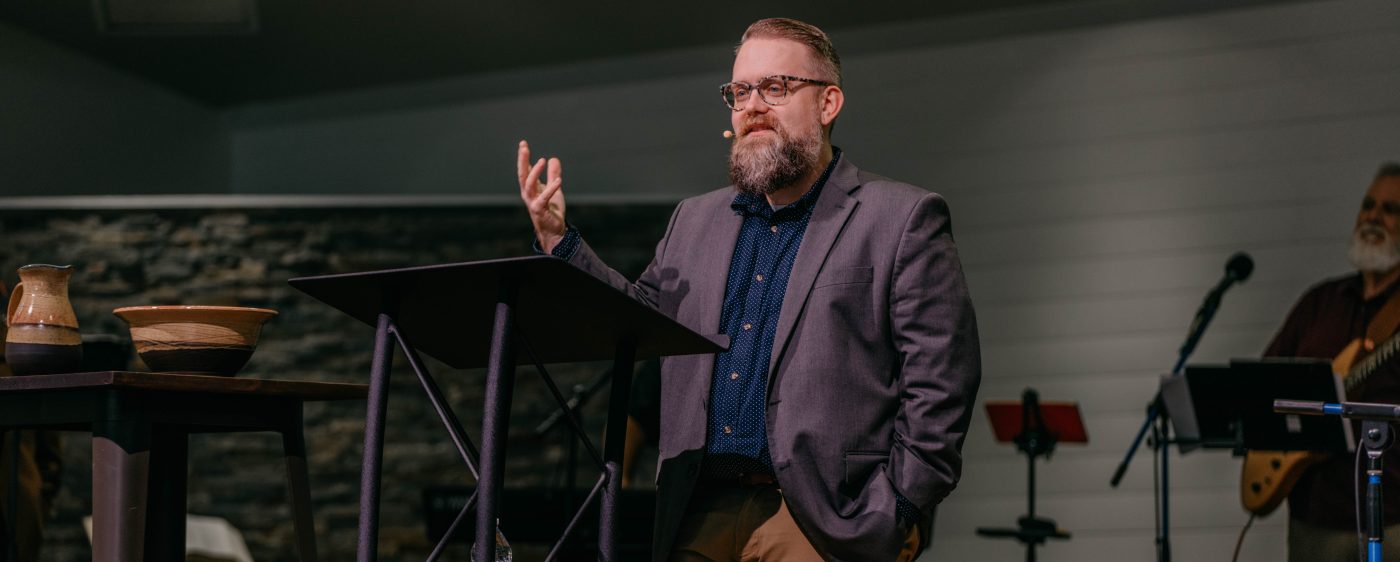
By Pastor Ryan Broadhurst
Our session at Westminster PCA recently voted to move to a weekly observance of the Lord’s Supper, beginning with the first Sunday of 2024. I am very enthusiastic about this change from our prior tradition of monthly communion as I believe this will be of great benefit to our church family in many ways. But as we prepare for this significant shift in our Sunday worship service, I want to help our congregation understand the thinking behind it from a few different angles. So over the next several weeks, I’ll be sharing articles I’ve written that speak to Biblical, Sacramental, Ecclesiological, & Evangelistic considerations as to why this is a “good thing”, along with some FAQ as well.
As with any important theological consideration, I want to start by pointing us to what Scripture has to say on the issue. First of all, let me make clear that I am not claiming that weekly communion is directly commanded by the Bible or that any church is necessarily “in sin” for doing it less frequently. However, I believe there is strong evidence of a pattern of weekly observance of this sacrament within the pages of the New Testament. Here’s a few passages for us to consider in that regard.
- Acts 2:42 – “And they devoted themselves to the apostles’ teaching and the fellowship, to the breaking of bread and the prayers.”
We see right at the beginning of the early church that their Christian gatherings were characterized by four things – teaching, fellowship, communion, and prayer. Now, our tendency is to think of this “breaking of bread” as simply the sharing of a meal. However, we see that these four activities in Acts 2:42 were specifically aspects of a worship service. Thus, most commentators agree that this phrase “the breaking of the bread” is actually shorthand for observance of the sacrament of the Lord’s Supper. In his commentary on this passage John Calvin wrote, “And my reason why I would rather have breaking of bread to be understood of the Lord’s Supper in this place is this, because Luke doth reckon up those things wherein the public estate of the Church is contained. Yea, he expresseth in this place four marks whereby the true and natural face of the Church may be judged.”
As Christians today, we continue to practice these same four aspects in our worship. We devote ourselves to the apostles’ teaching by weekly reading of and preaching from the Bible. We devote ourselves to weekly gathering together for fellowship with one another for mutual edification. We devote ourselves to weekly prayer as part of our worship service. And so, as elders, we also want to be weekly devoting ourselves to ‘the breaking of bread’ by a weekly observance of communion.
- Acts 20:7 – “On the first day of the week, when we were gathered together to break bread, Paul talked with them, intending to depart the next day, and he prolonged his speech until midnight.”
Another observation of the early church in Acts is how the day of worship (the Sabbath) shifted from the last day of the week to the first day of the week, in light of the resurrection of Christ, which took place on a Sunday. (We see this referred to as “the Christian Sabbath” in the Westminster Shorter Catechism #59.) So here in Acts 20:7, we read that the believers were gathered together “on the first day of the week” for the purpose of “breaking bread”. Recognizing, again, that this phrase “to break bread” is short-hand for observing the Lord’s Supper, we now see this combined with the fact that they were specifically meeting on the first day of the week, which again seems to hint at weekly observance of this sacrament as part of corporate worship within the early church.
If we look again to John Calvin’s commentary, he writes, “Though breaking of bread doth sometimes signify among the Hebrews a domestical banquet, yet do I expound the same of the Holy Supper in this place, being moved with two reasons. For seeing we may easily gather by that which followeth that there was no small multitude gathered together there, it is unlikely that there could any supper be prepared in a private house. Again, Luke will afterward declare that Paul took bread not at supper time, but after midnight… Therefore, I think thus, that they had appointed a solemn day for the celebrating of the Holy Supper of the Lord among themselves.”
So you see, when we encounter the phrase ‘to break bread’ as a frequent aspect of gathered worship in the book of Acts, I believe we are meant to immediately call to mind “the Lord’s Supper”. Additionally, in Acts 20:7 it seems to assume that partaking of the Lord’s Supper was the central aspect of their worship, right along with the apostle Paul’s teaching.
- 1 Corinthians 11:17-34 – “But in the following instructions I do not commend you, because when you come together it is not for the better but for the worse. For, in the first place, when you come together as a church, I hear that there are divisions among you. And I believe it in part, for there must be factions among you in order that those who are genuine among you may be recognized. When you come together, it is not the Lord’s supper that you eat. . . . “Do this, as often as you drink it, in remembrance of me.”… So then, my brothers, when you come together to eat, wait for one another— if anyone is hungry, let him eat at home—so that when you come together it will not be for judgment. About the other things I will give directions when I come.”
Finally, one of the most important passages for us to consider comes from Paul’s 1st letter to the Corinthian church. In 1 Corinthians 10-11, we have the most extensive teaching related to the Lord’s Supper, and in this passage in particular we see the phrase “when you come together” used 5 times. Why might that matter? Well, what Paul is addressing in this text is the proper observance of the Lord’s Supper, and so we should notice how he doesn’t say “if you happen to take communion when you gather”. Rather, he seems to indicate that “when you come together” the expectation is that the Lord’s Supper was involved. It is widely agreed that the terminology “come together” here is used as a technical term for gathering as the church, and so this is one more biblical consideration that seems to lend itself towards a weekly practice of this sacrament.
Additionally, the language of “Do this as often as you drink it” in 1 Corinthians 11:25 also suggests a frequent celebration of communion. To point to John Calvin once more, he said, “We ought always to provide that no meeting of the Church is held without the word, prayer, the dispensation of the Supper, and alms. We may gather from Paul that this was the order observed by the Corinthians, and it is certain that this was the practice many ages after.”
So, brothers and sisters, as we take these biblical considerations into account, I would suggest to you that it seems to reflect an apostolic pattern of weekly observing communion within the early church. As we seek to always be reforming ourselves to the Scriptures, this is one more way we can do just that as it relates to our weekly worship gathering. That being said, I realize this first article only scratches the surface on many other important questions and considerations as it relates to the Lord’s Supper, so hang tight as I address those in the weeks ahead. And as we contemplate these things, may it stir within us all a greater spiritual hunger for the righteousness of Christ our Redeemer.
 Ryan Broadhurst