
As many of you know I am taking some time to chronicle the reasons for my journey to Presbyterianism, and specifically how Amy & I came to newfound biblical convictions related to baptism. In my last two posts, I discussed the proper recipients of baptism (i.e. WHO should be baptized) and how baptism is a replacement for circumcision as the initiatory sign into the covenant community of God’s people. In other words, there is a continuity with how God works throughout the Bible in his covenants towards his people. And because of these things, we should baptize both believers AND their children. (For more on this see my posts linked below.). But one of the lynchpin considerations for me actually began with what is often referred to as the “mode” of baptism.
In my Baptist background, baptism was viewed as only being accomplished through full immersion of an individual into water, as opposed to other modes such as pouring or sprinkling. This was rooted in the following Scriptural arguments: 1) the Greek word βᾰπτῐ́ζω must mean dip/immerse/plunge, 2) baptism must be immersion because it symbolizes spiritual death, burial, and resurrection, and 3) the physical descriptions of baptism in Scripture were clearly immersion. These were the same Baptist arguments that I held and taught myself for many years and how I was trained to think of it in seminary. But my shift towards Presbyterianism really began as I reconsidered what the Bible actually taught as it relates to these arguments. (I was particularly helped by a short book called “William the Baptist” by James. M Chaney which you can find a free pdf of online.)
So let’s first consider the word βᾰπτῐ́ζω in its Scriptural usage. Is it true that the semantic range for this word is limited to immersion only? In Mark 10:38 we read, “Jesus said to them, ‘You do not know what you are asking. Are you able to drink the cup that I drink, or to be baptized with the baptism with which I am baptized?’” Here Jesus uses this same word for ‘baptism’ to speak of is the wrath of God which would be POURED out upon him on the Cross. In Luke 3:16 John the Baptist says, “… I baptize you with water, but he who is mightier than I is coming, the strap of whose sandals I am not worthy to untie. He will baptize you with the Holy Spirit and fire.” Again, the same word for ‘baptism’ is used to refer to the baptism of the Holy Spirit. So how does this Spirit baptism take place? We see the answer in Acts 2 (which also quotes Joel 2) saying the Holy Spirit was POURED out upon the disciples. Then we should consider Mark 7:4, where it speaks of the Pharisees’ traditions saying, “…And there are many other traditions that they observe, such as the washing (i.e. baptizing) of cups and pots and copper vessels and dining couches.” This washing is another use of the word for baptism that refers to not only small items such as dishes, which could conceivably be immersed, but also to “dining couches”. So we must ask, would they ‘baptize’ these dining couches by immersing them or could the word simply mean ‘to wash’ without necessitating plunging the item into water? Finally, in Hebrews 9:10 we see this same word used again to describe Old Testament ‘washings’. These ceremonial washing from the OT had various modes including sprinkling and pouring, along with immersion. So here we have 4 separate examples of the Greek word βᾰπτῐ́ζω (or its noun form βαπτισμός) showcasing a semantic range beyond ONLY immersing. Indeed, it can mean pouring or sprinkling as well.
Beyond the lexical use of the word for baptism/baptize, we also have the theological argument for baptism, such as we find in Romans 6 and Colossians 2. In both of these places, the apostle Paul says that baptism is meant to identify us with the death, burial, and resurrection of Christ. This I believe is one of the strongest arguments for the ‘immersion-only’ position. Romans 6:4 says, “We were buried therefore with him by baptism into death, in order that, just as Christ was raised from the dead by the glory of the Father, we too might walk in newness of life.” And Colossians 2:12 says, “having been buried with him in baptism, in which you were also raised with him through faith in the powerful working of God, who raised him from the dead.” This seems like a pretty slam dunk case at first glance. There is no doubt that one of the most important symbolisms behind baptism is that of identifying with Christ’s death/burial/resurrection for we were spiritually dead, buried, and raised to walk in new life! But there’s more to be considered here. First, is this the ONLY symbolism inherent behind baptism? Or does Scripture use baptism to symbolize other spiritual realities as well? For example, Hebrews 10:22 speaks of our hearts having been sprinkled clean and our bodies washed with pure water, which is undoubtedly a reference to baptism. This is an intentional call back to the New Covenant promise of Ezekiel 36:25-27, where the Lord says, “I will SPRINKLE clean water on you, and you shall be clean from all your uncleannesses, and from all your idols I will cleanse you. And I will give you a new heart, and a new spirit I will put within you. And I will remove the heart of stone from your flesh and give you a heart of flesh. And I will put my Spirit within you, and cause you to walk in my statutes and be careful to obey my rules.” So we see the spiritual cleansing through the blood of Jesus, as well as the baptism of the Spirit (which I mentioned earlier) are also important symbolisms tied to baptism. And not only that, but in consideration of the original argument of symbolizing Jesus’ burial, let me ask this: How was Jesus buried? Not underground in a grave as we would today or as we often think of in immersion-baptism. Jesus was entombed. So the ‘symbolic visual’ argument of immersion also falls short in this way. With these considerations in mind, I would argue that being buried with Christ in baptism does not necessitate being immersed. It’s language to describe something symbolically happening. Just as I would say to be ‘sprinkled clean’ or ‘have the baptism of the Spirit’ does not require sprinkling or pouring in order to still represent those spiritual realities.
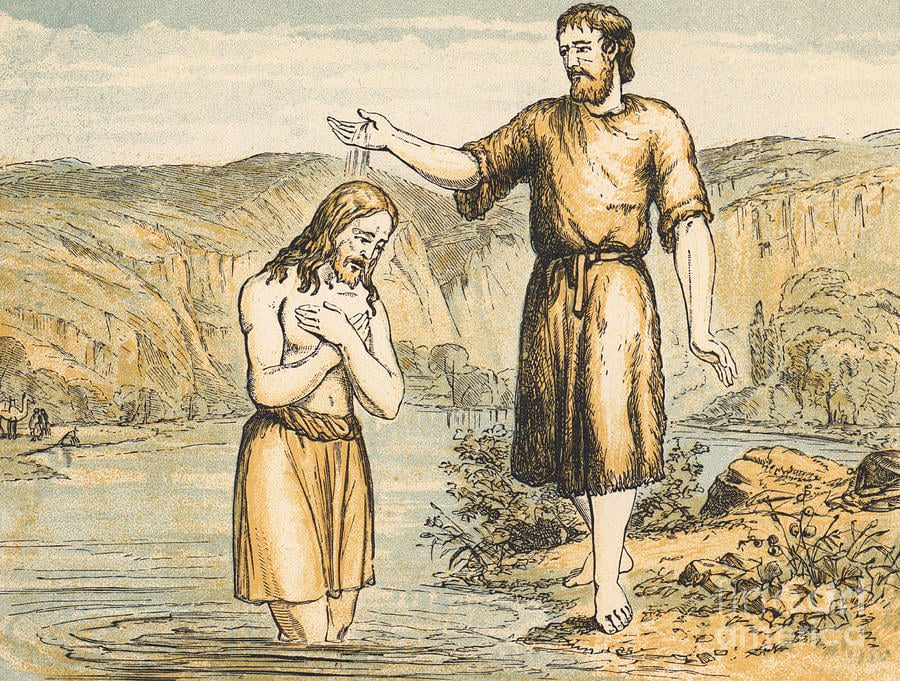
Finally we have to ask: what about the physical descriptions of the baptisms that take place? In Mark 1:10 and Matthew 3:16, we read that after his baptism Jesus ‘came up out of the water’. Doesn’t coming up out of the water indicate that this baptism was an immersion? Well, let’s also consider Acts 8:36-40 where we have Philip and the Ethiopian eunuch. They spot a body of water and pull over for the eunuch to be baptized. BUT, interestingly, it says they BOTH go down into the water (v38), and they BOTH come up from the water (v39). This is the same Greek word (ἀναβαίνω) that gets used when Jesus ‘came up’ from the water. So if we argue that this meant Jesus was immersed, we must argue that Philip immersed HIMSELF along with the Ethiopian eunuch. Why would Philip do that? Rather, I’d argue that this is not a clear case of immersion at all. It seems, instead, that the baptizer and the one being baptized would stand in a body of water, and then water could have been poured or sprinkled whilst they stood there, then they would come up out of the water to the shore – where the Spirit would descend on Jesus and that same Spirit in Acts 8 would carry Philip away. It was my friends Scott & Leigh Anne Davis who first presented this argument to Amy & me a few years ago – long before we became convinced – and showed us the first painting I had ever seen of Jesus’ baptism that depicted pouring instead of him being immersed (similar to the photo I have attached to this post). But it doesn’t stop there either… in 1 Corinthians 10:1-2, Paul speaks of the Israelites having undergone a ‘baptism’ through the Red Sea. But if you think about that historical account, it was the Egyptian army who was immersed in the floods of God’s judgment. The Israelites were sprinkled upon by the waters as they passed through on dry land. And in 1 Peter 3:21-22, the apostle Peter relates baptism to what happened with Noah and his family in the ark. Again, let’s remember – it was only those receiving God’s judgment who were immersed. Noah and his family were ‘baptized’ by the rain sprinkling down upon them. (Also as a side note, we see baptism used in both of these cases for almost certain inclusion of children – the Israelites & Red Sea as well as Noah & his household.)
So when it comes to baptism – immersion is fine! But it is not the only way. Sprinkling and pouring are biblically acceptable (some might even argue preferred) modes as well. So long as it is a washing with water in the name of the Father, the Son, and the Holy Spirit.
All that being said, let me reiterate that this is just one part of embracing a Presbyterian view, and I do still have more to write in the days ahead which, along with my previous posts, I hope will help others understand how we arrived at seeing paedobaptism as the biblical teaching. As always – Feel free to interact, ask questions, etc. but keep it respectful, and I’ll do my best to respond.  Thanks for reading y’all!
 Ryan Broadhurst