In my last post, I began writing on our shift from being baptists (believing baptism is for believers only) to being Presbyterians who believe that baptism is meant to be applied to believers as well as their children. Another significant part of coming to this biblical conviction is seeing that the Bible teaches baptism is really a replacement for circumcision. Now, coming from a baptist background we really didn’t spend a ton of time talking about circumcision, and let’s be honest – it can be a bit awkward to discuss at length the important physical sign of cutting off a male’s foreskin. Yet, Scripture makes a big deal out of circumcision. This goes all the way back to Genesis 17 and the sign of the covenant God made with Abraham. God marked off his people by saying every male in Abraham’s lineage should be circumcised. Abraham received ‘believers’ circumcision as it were, and his offspring would receive infant circumcision. It was a bloody sign on the most intimate part of the male body was forever ‘branded’ by God as a reminder of his covenant promises to them – to be a God to them and their children. Those male converts or servants who were added to God’s people would receive ‘believers circumcision’ akin to Abraham, and then their progeny would be marked accordingly as they were born.
This idea of circumcision, awkward as it may be to modern minds, is quite prominent throughout Scripture. We read of its importance to God’s people throughout the pages of the Bible, and often Gentiles and unbelievers are even referred to as the uncircumcised. And the importance of this sign had to do with this fact: God never intended for the Israelites to simply think they only had to experience the outward sign of circumcision. Rather, it was always meant to point to the need for them to have circumcised hearts (Deut. 10:16) – meaning that they would have personal believing faith in the promises of God. It was possible for those who were circumcised outwardly to not be circumcised inwardly. We see this right from the get go with Abraham’s two sons. Isaac showed himself to have true, saving faith, whereas Ishmael did not. Both had received the external sign, but only one of them showed themselves to also experience inward salvation (or circumcision of the heart).
So, for thousands of years the sign of God’s people was given to believers and their children. Generation passed down to generation. Children were always included in receiving this external marking and were called to believe in the promises it pointed to. Then, we get to the New Testament. Under the New Covenant, Jesus institutes a new external sign for his people – baptism. In Matthew 28 we read, 18 And Jesus came and said to them, “All authority in heaven and on earth has been given to me. 19 Go therefore and make disciples of all nations, baptizing them in the name of the Father and of the Son and of the Holy Spirit, 20 teaching them to observe all that I have commanded you. And behold, I am with you always, to the end of the age.” Now, this was one passage that my baptist upbringing taught me well and often! The call for us to make disciples is essential to our commission as Christians. And from a baptist reading, one might argue that logically Jesus must be saying FIRST you make disciples, THEN after that you baptize them, THEN after that you teach them. However, what I came to realize is that actually Jesus is saying – go and make disciples, and HOW you go about doing that is through baptizing and teaching them. This is an important distinction to make as it both reflects a more natural reading of the passage and reminds us that God’s people consist of both believers and their children. Yes, that’s right – Matthew 28 is a passage on infant baptism too!  Insofar as it is about making disciples. And the truth is… I didn’t wait to become a Presbyterian to start discipling my kids. We all do! We teach them to pray, to read God’s Word, to understand the Gospel, and to sing ‘Jesus loves me’ from before they can even talk. They are disciples, and as such should receive the sign of baptism along with that teaching. [As an aside, my children are awaiting their baptism. In the PCA, you have to be an ordained teaching elder to administer the sacraments, and as part of my journey in this area, I look forward to being credentialed so that I can then personally baptize my kiddos – hopefully in the near future!]
Now – back to the correlation to circumcision. Baptism is now the sign of God’s people, and after thousands of years of believers and their children receiving the covenant sign, are we to now believe that such is no longer the case? And not only that, you’d expect a pretty major debate on this issue in the early church, but we see no such thing. So whereas baptists assume we shouldn’t give the sign of baptism to our children because the NT nowhere *explicitly* states to do so, Presbyterian & Reformed folks would say the assumption should go the other way. As B.B. Warfield succinctly stated it: “The argument in a nutshell is simply this: God established his Church in the days of Abraham and put children into it. They must remain there until He puts them out. He has nowhere put them out. They are still then members of His church and as such entitled to its ordinances. Among these ordinances is baptism, which standing in similar place in the New Dispensation to circumcision in the Old, is like it to be given to children.”
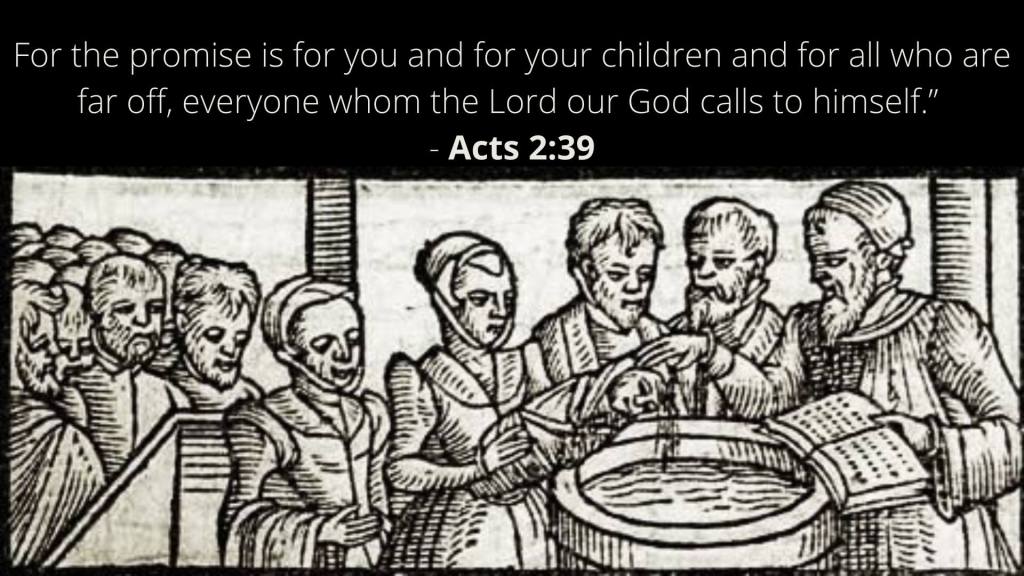
As I said in my last post, Acts 2 & elsewhere in the New Testament we see households continuing to be an important theme. Not only that, but we see that the New Covenant sign is a BETTER sign than circumcision. It is given to females now, not just males (as in the case of Lydia in Acts 16). It is given to gentiles as well as Jews (as in the case of Cornelius & his household in Acts 10). The sign of baptism is greater because it can even be given to an Ethiopian eunuch (as in Acts 8 ), who obviously would not have been physically capable of receiving the sign of circumcision. Also, it is a bloodless sign – a washing with water – because Christ has bled for us in his ‘circumcision’ on the cross.
Lastly, and most clearly, in Colossians 2:11-12 the Apostle Paul directly correlates the replacement of circumcision with baptism when he says: “11 In him [Jesus] also you were circumcised with a circumcision made without hands, by putting off the body of the flesh, by the circumcision of Christ, 12 having been buried with him in baptism, in which you were also raised with him through faith in the powerful working of God, who raised him from the dead.” What is the circumcision of Christ? Baptism. The new sign instituted by our Lord to mark off his people. Again, this doesn’t mean they are necessarily born again because they are baptized. It doesn’t promise that they will have saving faith. A sign is not the thing it signifies. A sign for Popeye’s chicken points to the reality of Popeye’s chicken and where it can be found, but is not in itself a delicious spicy Louisiana-style delicacy. It’s a sign. Similarly, baptism (like circumcision was in the OT) is an outward marker that points to an inward reality. The Israelites were meant to consider their circumcision and remember their need to have regenerate (circumcised) hearts. And as Christians, we are meant to consider our baptism and remember our need to be washed clean of our sin and be filled (baptized) with the Holy Spirit by clinging to the hope of salvation by grace alone through faith alone in Christ alone.
As I said on my last post, this is just one part of embracing a Presbyterian view, and I still plan to write still more in the days ahead. By the way, in doing this I’m not trying to necessarily convince everyone to come join me in Presby-world, but just to help explain my own transition and how it really comes from a Biblical conviction. Feel free to interact, ask questions, etc. but keep it respectful, and I’ll do my best to respond. 
(This is an older post previously only shared on Facebook.)
 Ryan Broadhurst